carsrequest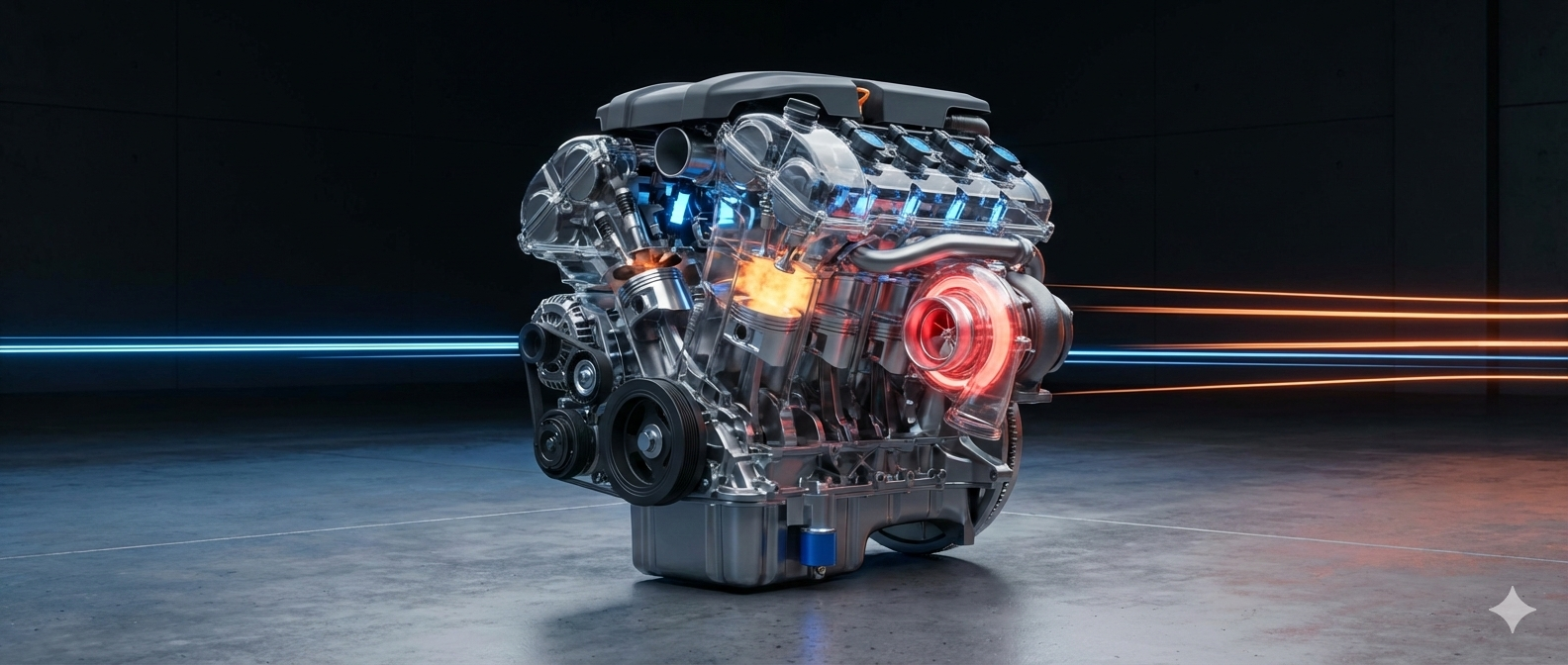
From naturally aspirated purists to twin-turbo powerhouses, we break down the confusing world of automotive spec sheets.
Introduction
You’re looking at a car brochure or browsing our latest inventory online. You see a stunning vehicle you like, and then your eyes drift down to the technical specifications.
“3.0L Twin-Scroll Turbocharged Inline-6 with Direct Injection.”
It sounds impressive, but what does it actually mean for your daily drive?
At Cars Request Africa, we believe an educated buyer is a happy owner. Understanding what’s happening under the hood isn’t just for mechanics; it helps you choose the right vehicle for your lifestyle, whether you need fuel-sipping efficiency for the commute or tire-shredding torque for the weekend.
Today, we’re stripping away the jargon to explain the evolution of the internal combustion engine. Buckle up; we’re going deep into the engine bay.
The Basics: Suck, Squeeze, Bang, Blow
Before we dive into turbos and injection, we need to understand the foundation. Almost every car on the road today uses a four-stroke internal combustion engine.
Think of your engine as a giant air pump. To make power, it needs to do four things in rapid succession inside each cylinder:
-
Intake (Suck): The piston goes down, sucking in air and fuel.
-
Compression (Squeeze): The piston goes up, squeezing that mixture into a tiny, highly explosive ball.
-
Combustion (Bang): The spark plug fires, igniting the mixture. The resulting explosion forces the piston down violently—this is where the power is made.
-
Exhaust (Blow): The piston moves back up, pushing the leftover burnt gases out the exhaust pipe.
The various engine types listed below are essentially different ways of optimizing these four steps to get either more power, better efficiency, or both.
Part 1: Air Induction (How the Engine Breathes)
The biggest limitation on an engine’s power is how much air it can gulp down. The more air you get into the cylinder, the more fuel you can burn, and the bigger the “Bang.”
1. Naturally Aspirated (NA) The Purist’s Choice
For decades, this was the standard. A naturally aspirated engine relies solely on the downward movement of the piston to create a vacuum and suck air in at atmospheric pressure.
It’s like breathing normally. You aren’t forcing air into your lungs; your diaphragm is doing the work.
The History: From the very first Ford Model T to the screaming Formula 1 V10s of the early 2000s, NA engines ruled the world. They are known for instant throttle response (no lag) and, usually, an incredible exhaust note.
-
Pros: Simple, reliable, instant power delivery, great sound.
-
Cons: Limited power potential compared to forced induction; struggles at high altitudes where the air is thin.
2. Turbocharged: Efficiency Through Recycling
If an NA engine is breathing normally, a turbocharged engine is like having someone blow air into your lungs while you run.
A turbocharger is essentially an air compressor driven by an exhaust gas turbine. It takes the wasted energy coming out of your exhaust pipe and uses it to spin a fan. That fan is connected to another fan that forces compressed air into the engine intake.
The History: Turbocharging started in aircraft to help them breathe at high altitudes. It entered the automotive mainstream in the 70s and 80s (think Porsche 911 Turbo or Saab 900). Early turbos suffered from massive “turbo lag”—a delay between pressing the gas pedal and waiting for the turbo to spin up and provide power.
Modern turbos have largely solved this lag, offering incredible power from smaller, more fuel-efficient engines.
-
Pros: Massive power gains from small engines, better fuel economy when not under heavy load.
-
Cons: Can still have slight lag, adds complexity and heat under the hood.
3. Twin-Turbocharged: Double Trouble
Why have one turbo when you can have two? Twin-turbo setups usually work in one of two ways:
-
Parallel: Two smaller identical turbos, each feeding half the engine (e.g., one turbo for each bank of a V6 or V8). Smaller turbos spool up faster than one giant one.
-
Sequential: A small turbo for low speeds (quick response) and a large turbo for high speeds (massive top-end power).
A great example of this evolution is the shift from the Mercedes-AMG E43 (Twin-Turbo V6) to the newer engines that utilize electric auxiliary compressors to eliminate lag entirely.
4. Supercharged: Instant Gratification
Like a turbo, a supercharger forces air into the engine. However, instead of being powered by exhaust gas, it is mechanically driven by a belt connected directly to the engine’s crankshaft.
Because it’s mechanically linked, there is zero lag. When you hit the gas, the power is there instantly. The downside? Because the engine has to physically spin the supercharger, it saps some efficiency (parasitic loss).
-
Pros: Zero lag, incredible low-end torque, whining sound that enthusiasts love.
-
Cons: Less fuel-efficient than turbos.

Part 2: Fuel Delivery (How the Engine Eats)
Getting air in is half the battle; you also need to introduce fuel precisely.
1. Port Injection (Multi-Point Injection)
For a long time, this was the standard upgrade over carburetors. Fuel injectors spray gasoline into the intake ports just before the air enters the cylinder. The air and fuel mix “outside” the main chamber.
-
Pros: Reliable, simpler technology, the fuel spray helps clean the intake valves.
-
Cons: Less precise fuel control, lower potential for compression and efficiency compared to direct injection.
2. Direct Injection (GDI / FSI)
This is the modern standard. In a direct-injection engine, the fuel injector is located right inside the combustion chamber. It sprays highly pressurized fuel directly into the cylinder at the exact microsecond it’s needed.
This allows engineers to run much higher compression ratios (a tighter “Squeeze”), resulting in a bigger bang from less fuel.
-
Pros: Better fuel economy, lower emissions, higher power output.
-
Cons: More complex, high-pressure fuel pumps are expensive, and intake valves can suffer from carbon buildup over high mileage because no fuel is washing over them..
Which Engine is Right For You?
Understanding these terms helps you decipher what a car is designed to do.
-
Are you looking for a pure, classic sports car experience with immediate throttle response? You might seek out a high-revving Naturally Aspirated engine.
-
Do you want maximum fuel economy for city driving but need passing power on the highway? A small-displacement turbocharged with Direct Injection engine is likely your best bet.
-
Do you want absolute, tire-shredding domination? Look for Twin-Turbos or big Supercharged V8s.
Still Confused? Let Us Help.
Reading about engines is one thing; experiencing them is another.
At Cars Request Africa, our team lives and breathes this technology. We don’t just sell cars; we understand the engineering marvels underneath the hood.
If you are debating between a turbocharged commuter or a naturally aspirated weekend cruiser, come visit our showroom. We’ll happily pop the hoods, explain the differences in person, and, most importantly, get you behind the wheel so you can feel the difference yourself.