carsrequest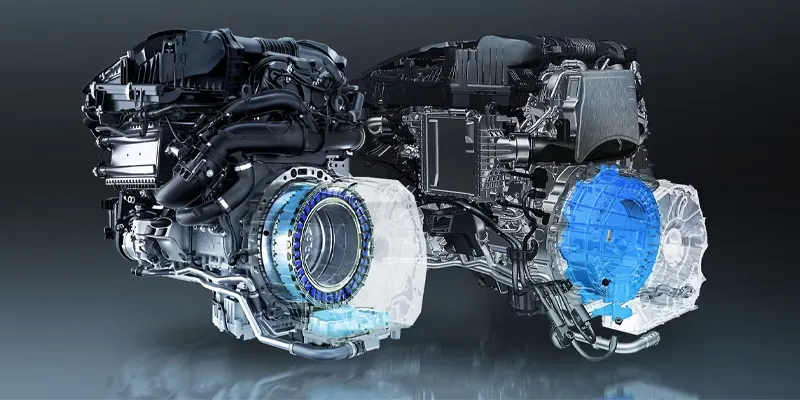
Mercedes-Benz ISG Integration vs. EQ Boost Explained
For over a century, the internal combustion engine (ICE) relied on a simple mechanism to start and charge: a belt-driven starter motor and an alternator. However, as global emissions standards tightened and driver demands for instant throttle response grew, Mercedes-Benz pioneered a hybrid solution that bridges the gap between traditional gas engines and full electric vehicles.
This innovation involves EQ Boost and the Integrated Starter-Generator (ISG). While these terms are often used interchangeably in dealership brochures, they represent two distinct aspects of the Mercedes mild-hybrid ecosystem: the technology branding (EQ Boost) and the physical hardware (ISG).
The History: How Mercedes Reimagined the Engine Block
In the mid-2010s, Mercedes-Benz began developing its modular engine family, culminating in the release of the M256 inline-six engine in 2017 (debuting on the W222 S-Class).
Instead of adding heavy battery packs like a traditional plug-in hybrid (PHEV), Mercedes introduced a 48-volt electrical architecture. To make this architecture work, engineers eliminated the traditional belt drive system on the front of the engine.
-
The Old Way: Belts driven by the crankshaft ran the water pump, air conditioning compressor, alternator, and power steering pump, causing parasitic power draw.
-
The New Way: All auxiliary components were converted to run on 48-volt electric power. This freed up space at the front of the engine, making the M256 inline-six shorter, lighter, and far more efficient.
To take the place of the alternator and starter motor, Mercedes introduced the ISG, marketing the resulting performance boost under the EQ Boost sub-brand.
Hardware vs. Branding: Defining the Terms
Understanding the difference comes down to hardware versus application:
+-------------------------------------------------------------------+
|                            EQ BOOST                               |
|        (The Umbrella Branding & Mild-Hybrid Tech Suite)           |
|                                                                   |
|   +-------------------+  +-------------------+  +---------------+  |
|   |  48V Lithium-Ion  |  | Integrated Starter |  |  Auxiliary    |  |
|   |     Battery       |  |  Generator (ISG)   |  | Electric      |  |
|   |   (Rear Mounted)  |  |  (Engine/Trans)   |  | Compressors   |  |
|   +-------------------+  +-------------------+  +---------------+  |
+-------------------------------------------------------------------+
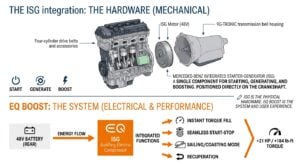
1. Integrated Starter-Generator (ISG) — The Hardware
The ISG is a compact, disk-shaped electric motor mounted directly between the internal combustion engine and the transmission flywheel.
It performs three distinct roles:
-
Starter: Spins the crankshaft instantaneously to start the engine without traditional starter gear noise or delay.
-
Generator/Alternator: Converts kinetic braking energy into electricity to recharge the 48V battery (Recuperation).
-
Electric Motor: Supplies supplemental power directly to the driveshaft.
2. EQ Boost — The System & Experience
EQ Boost is Mercedes’ overall name for its 48V Mild-Hybrid Electric Vehicle (MHEV) system. EQ Boost utilizes the ISG alongside a $0.9\text{ kWh}$ lithium-ion battery and an electric auxiliary compressor (e-turbo) to enhance vehicle performance.
(Note: In recent model years, Mercedes-Benz has begun shifting away from the “EQ Boost” moniker, simply referring to these vehicles as “Mild Hybrids with 48V Technology” to avoid confusion with their all-electric “EQ” range, such as the EQE and EQS).
Core Features & Functionality
The ISG-driven EQ Boost system introduces several key automotive advancements:
1. Instant Torque Fill & Elimination of Turbo Lag
Turbochargers require exhaust gas pressure to spool up and generate boost. During those fraction-of-a-second delays (turbo lag), the ISG instantly injects up to 21 hp and over $184\text{ lb-ft}$ ($250\text{ Nm}$) of electric torque directly to the drivetrain.
2. Seamless Start-Stop Functionality
Traditional auto-start-stop systems are notorious for shuddering when the engine reignites at a red light. Because the ISG sits directly on the crankshaft, it brings the ICE up to idling speed smoothly and almost silently within milliseconds, making stop-start intervention virtually imperceptible to the driver.
3. “Sailing” or Gliding Mode
When driving in ECO mode at highway speeds, lifting off the accelerator allows the engine control unit (ECU) to shut off the combustion engine completely. The vehicle coasts (“sails”) without consuming fuel or producing emissions, while the 48V system maintains power steering, climate control, and cabin electronics. Pressing the throttle instantly restarts the engine via the ISG without lag.
4. Regenerative Braking
When coasting or pressing the brake pedal, the ISG switches into a generator. It creates magnetic resistance to slow the car down while capturing kinetic energy that would otherwise be lost as heat, directing it back into the 48V battery.
Technical Comparison Matrix
| Feature | Belt-Driven Starter/Alternator (Traditional) | EQ Boost System with ISG (Mild Hybrid) |
| Electrical Voltage | 12V System | Dual 12V / 48V System |
| Engine Belts | Multiple drive belts (Parasitic loss) | Beltless front-engine design |
| Placement | Mounted on exterior engine block | Integrated between engine & transmission |
| Restart Speed | ~0.8 – 1.0 seconds (Noticeable shudder) | ~0.2 seconds (Inaudible & smooth) |
| Performance Gain | None | Temporary performance boost |
| Coasting Capability | Engine runs at idle speed | Engine completely shuts off (“Sailing”) |
Evolution and the Future
Mercedes-Benz first debuted this 48V ISG setup on six-cylinder models like the CLS 450, GLE 450, and AMG 53 lineup. Following its success, Mercedes introduced ISG 2 (Second-Generation ISG), which was integrated directly into the housing of the 9G-TRONIC transmission rather than on the engine block.
This second-generation design allowed Mercedes to deploy ISG technology across four-cylinder engines (such as the C 300 and E 300) as well as twin-turbo V8s (such as the GLE 580 and GLS 600 Maybach).
By unifying high-performance electric torque fill with reduced emissions, the ISG integration stands as one of the most significant bridge technologies in automotive engineering—giving ICE vehicles the instantaneous responsiveness of an EV without range limitations.
References
-
BenzUnited Parts: Mercedes EQ Boost & M256 Inline-6 Explained (2025)
-
J.D. Power: What is Mercedes-Benz EQ Boost Engine Technology? (2021)
-
Mercedes-Benz of Littleton: EQ Boost Makes Your Gas Mercedes More Efficient (2022)
-
Mercedes-Benz of Princeton: What is Mercedes-Benz EQ-Boost?
-
Mercedes-Benz of Akron: Mercedes-Benz Mild Hybrid Overview